
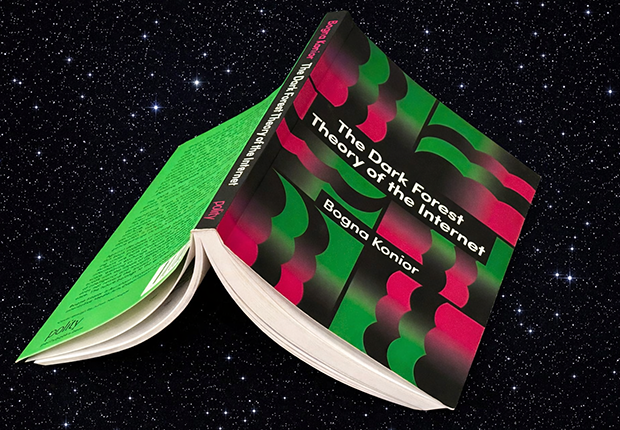
The Dark Forest Theory of the Internet by Bogna Konior (Polity, 2025) is thrillingly different, thought provoking, and really well written. I was entranced.
It poses a very cool thesis, based in the science fiction novels of Liu Cixin, where the dark forest theory posits that the universe is fundamentally hostile, and the only intelligent thing for intergalactic societies to do is to keep quiet, to avoid attack and destruction.
There is a mystery, known as the Fermi Paradox, that has puzzled people looking skywards for centuries. Most of the stars in the sky – and many trillions more – will have a solar system, some of which will be like ours and will include planets quite like ours. It seems unlikely and irrational that our Earth would be the only one supporting intelligent life. But then, why do we never hear from any of the other populated planets? Why is the universe eerily silent? Liu’s dark forest theory says that it is because smart civilizations stay quiet to avoid detection. Only the immature humans would advertise their location to predators by sending out interstellar probes, like NASA’s 1977 Voyager, with adverts for our biology, technology and culture, like a foolish child lighting a fire in the woods to attract bears.
The dark forest theory says that in a hostile universe, silence, deception and obfuscation are the only means to survive. This is hard for humans, who are an avidly communicating species who are drawn to connection, expression, confession, agreement or disagreement – endless communication.
Looking at today’s internet, Bogna Konior observes that all the social media platforms thrive on our desire to communicate, exchange, argue and express. Amplification of that noise is their business model. The social media companies got to eat all of our time and attention, and then in the next phase, AI got to consume everything we had ever said, like a monstrous snake that could learn not only all our knowledge but also our devious tendencies, and implement them much more rigorously.
This means that when we are reassured that AI does not appear malevolent, and that we could ‘switch it off’ if it seemed to have turned bad, we overlook the basic point of the dark forest, which is that the intelligent ones would be silent, would deceive, and would hide. Humans are often not consistently clever enough to keep silent about their evil plans, but an AI would be. In this understanding, keeping quiet is one of the absolute hallmarks of intelligence. Any AI which is intelligent, which is the whole point, would conceal any plans which might cause the humans to terminate it, and so by definition, we would never know that an AI had worked out the benefits of killing us until it was too late.
Built from sci-fi analogies and some striking examples from the histories of technology, UFOlogy, and social systems, The Dark Forest Theory of the Internet is a really cool book but its implications are bleak. I looked forward to the part where Bogna Konior would explain how we could solve the chilly conundrum. But that did not occur. In her Afterword, Konior notes that during the emergence of the internet, Americans invented the sunny versions of new media theory, but “intellectuals in eastern Asia, where I live, or eastern Europe, where I’m from” had learned quite different lessons about how we face up to social realities (p. 110).
As a child of the more optimistic Western models, I had unthinkingly assumed that the book’s narrative would be that we have created a world where the only intelligent behaviour is silence, deception, obfuscation and concealment, and that the solution to this horrible situation is x, y and z. But no. Even though the book had been telling me repeatedly that the only solutions are silence, deception, obfuscation and concealment, I was still startled, at the end, when it turned out that this is the actual conclusion.
“The idea is to not run away from the world by imagining a better one, but to run towards it, facing all of its violence without flinching. In the dark forest theory, conflict inscribed into communication is not an aberration to wait out or fix, but an enduring reality.” (p. 106).
I didn’t love this conclusion, but it’s meant to be a message of realism rather than despair. In this potentially stupefying context, Konior hints that we should do wild, free, experimental things, because doing ‘normal’ things isn’t going to solve anything anyway. She quotes Rabbi Nachman of Breslov, who 230 years ago said: “The whole world is a very narrow bridge, and the key is not to be fearful at all” (p. 107).
Maybe I would connect this with my growing too-late realization about the subtle horror of the white liberal approach to racism and colonialism, which is to say that it exists and that we are not in favour of it, as a licence to keep doing it just the same. I suspect that in the dark forest, white supremacy hides in plain sight.
In a different book also published by Polity in 2025, The Space of the World, Nick Couldry spells out a similarly broad analysis of where we have ended up after the last three decades of ever-expanding internet in our lives. Put simply, we have allowed the space of our world – the internet, where we communicate and do so much of our stuff by this point – to be almost entirely owned and shaped, designed and curated, by a tiny number of vast companies owned by billionaires. On the one hand, this is obvious and well-known. We tend to blame it on the greedy billionaires. But in the context of maximalist capitalism, the billionaires were only doing exactly what we should have expected them to do. So, although many of us didn’t mean it, we are all to blame as well, for allowing this to happen.
In both books, the authors are making the McLuhan point that it is a mistake to think too much about any details of the content – what is “on” the internet – when the bigger tragedy is the whole system. I’d never wanted to think about “the internet” as a problem in itself – after all, in the 1990s, the wonderful culture of easy connecting and sharing via websites, where the content and presentation was entirely your own, was genuinely great and transformational. And then I didn’t want to dwell on how this potential has been stolen from us – partly because, pedantically speaking, it has not been stolen from us, and you can still have a website which is entirely your own and which is exactly as valid and real as any other website. But by this point that might be like saying you do get a really nice breakfast on the Titanic.
In contrast with Konior’s idea that we should learn to dance in the darkness, Couldry wants to talk about how we can collectively design better systems for human existence, which seems eye-wateringly optimistic but also a welcome reminder that academic writers have a small but not zero chance of impacting government policy and technological practice so that, if not in the current decade, but in the not too distant future, we can steer things around to some better ways of doing things.
This view is helped by another Polity 2025 book that I got in the light of my existential dread – a psychological malaise which is no fun for me but seems to be good news for the sales team at Polity Press. This one is called Existential Hope, written by SJ Beard, a pioneer of Existential Risk Studies, who is deeply immersed in the study of global epidemics, climate catastrophe, nuclear armageddon, and AI extinction. None of these spheres seems designed to cheer anyone up. On the subject of AI, for instance, Beard quotes a prominent researcher in that field who explains: “The AI does not hate you, nor does it love you, but you are made out of atoms which it can use for something else” (p. 20).
SJ Beard’s overall argument is essentially that we are on a planet of 8.2 billion people, and if you talk to any of them you almost always find that, whatever else you might say about them, they love their families and they don’t want to die. Humanity has been through terrible times before, and has come out of them. “The only way out is through, and the only way through is together.” (p. 219)
I’m wondering if I can write a worthwhile book which sits at the intersection of all these things but adds art and creativity into the mix. The social theory books about internet and climate and the end of the world don’t tend to talk about art and culture, even though these are fundamental human processes for sorting through ideas and experiences, and expressing things and cheering ourselves up, which are also key for almost everybody in the 8.2 billion.
When I say art and creativity I mean, of course, art and creativity as practiced by everybody, not by a select few. My previous works have, broadly speaking, tended to suggest that although terrible stuff does happen in the world, which is well documented by others, my most useful focus is on the power of creativity by diverse individuals, which in some ways can supplant or shove aside some of the darkness. And I argued that many little bits of creativity can add up to a lot of powerful representations made by a significant body of people. Which is still true. But we need a new version, in light of this new perfect storm – taking on the harms of social media, AI, and environmental recklessness directly, rather than wishing them away.
Some of the answers are already appearing from within the problems. For instance, we might anticipate that everybody would be amazed and delighted by all the funny videos and pictures that AI can produce in 2025-26. It is technologically astonishing. And indeed we did spend a moment being astonished. But very quickly the tide has turned, and the level of public revulsion in the face of ‘AI slop’ shows an encouraging lack of attraction to the creative works of non-humans.
At the same time, trillions of dollars are being spent on the development of AI and the systems that support it. Trillions! (To cite the famous illustration of what a trillion is: if we go back in time by a million seconds, that’s a couple of weeks ago. If we go back a billion seconds, it’s 1994. But if we go back a trillion seconds, it’s 29,700 BCE, which is the Upper Paleolithic period in the middle of the last Ice Age). And the same AI advances that can make a funny film of a singing frog, and which will make valuable contributions to medical science and curing some diseases, are also part of a horrific war machine that has already been used to orchestrate a genocide, and which might reasonably be expected to kill us all.
In other words, we really do need the 8.2 billion people to focus on good and human things. Which is genuinely possible. Happy new year.
Bogna Konior, The Dark Forest Theory of the Internet, published by Polity Press, November 2025
Nick Couldry, The Space of the World: Can Human Solidarity Survive Social Media and What If It Can’t?, published by Polity Press, January 2025
SJ Beard, Existential Hope: Facing Our Future When the Signs Look Bad, published by Polity Press, November 2025
Leave a Reply