
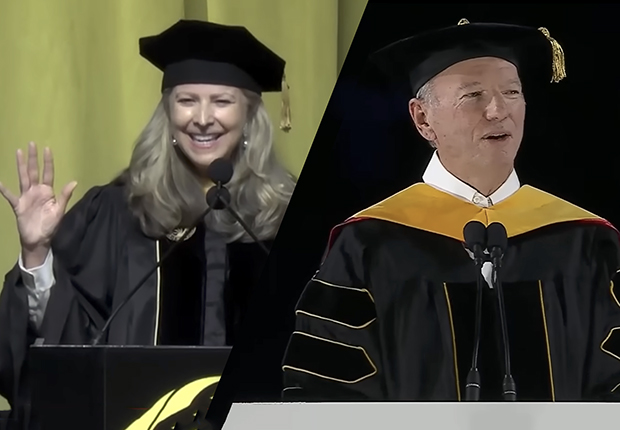
You’ve probably seen the videos, all from May 2026. At a commencement ceremony at the University of Central Florida, the students – who are there to celebrate their hard work and educational achievements – have to listen to a middle-aged white woman hail the rise of artificial intelligence (AI). They boo heartily and in great number. She seems surprised.
At a commencement ceremony at the University of Arizona, the happy times are shredded as a middle-aged white man beams about the ‘transformations’ of AI. He is greeted with a massive round of booing.
The man was Eric Schmidt, the former CEO of Google. The woman was Gloria Caulfield, the “Vice President of Strategic Alliances” at a business development company in Florida. Her website is more succinct: it says that she is a “visionary”. Sadly, on that particular day, her visionaryness had not extended as far as telling her that graduating students might not want to be reminded that AI has destroyed their future.
In another instance, music executive Scott Borchetta, already despised by younger generations for his role in Taylor Swift’s career, seems to enjoy taunting the graduating students at Middle Tennessee University about the rise of AI – “deal with it” is his thoughtful advice – and is booed in great volume.
The past several decades have been no strangers to technological change, as fresh young ideas challenge those of the older generations. But the striking thing about these recent cases is that it is older, privileged people who are sure that we must embrace the brave new AI dawn, while Gen Z [ages 14–29] feel that although AI tools may seem useful or fun, they are pretty sure that on the whole, AI is ruining everything, and should never have been invented.
A Gallup poll from April 2026 found that only one in five members of Gen Z in the USA were “excited” or “hopeful” about AI. One in three reported that they felt “angry” about AI and almost half of them were “anxious” about it.
These young people are not technophobic per se, of course, and are very familiar with AI. Despite its apparent helpfulness, a striking 80 per cent of them felt that AI would make it “more difficult for them to learn in the future”, with many feeling that it would undermine their creativity and critical thinking.
Unlike the creepy Scott Borchetta, they can see that AI is not a tool but a corrosion, like dumping a vat of acid on a whole list of things that we actually want: art and culture made by people who have real lives, experiences and relationships; a livable environment; careful and empathic thinking; and the possible avoidance of an authoritarian white-supremacist corporate state owned by billionaires who obviously are not going to share the AI-accelerated wealth with the likes of you and me.
It seemed that the privileged over-50s who had acquired property when it was much cheaper, and then pulled the ladder up behind them, had done their worst to younger generations. But the AI celebrants are here, at your graduation ceremony, to say no, we had not done our worst: look at this, and rejoice.
This is grim. But take heart: let us hope that the graduating students bring their heartfelt insights into the post-university world, and shovel these atrocious rich oldies onto a golf course somewhere, where they can be stupid with other stupids, and do less harm.
Leave a Reply